The name and the record
TB-500: a name in search of a clinical record
I expected the most revealing TB-500 papers to be about healing. Several were about finding it in racehorse samples. That is where this story gets interesting.
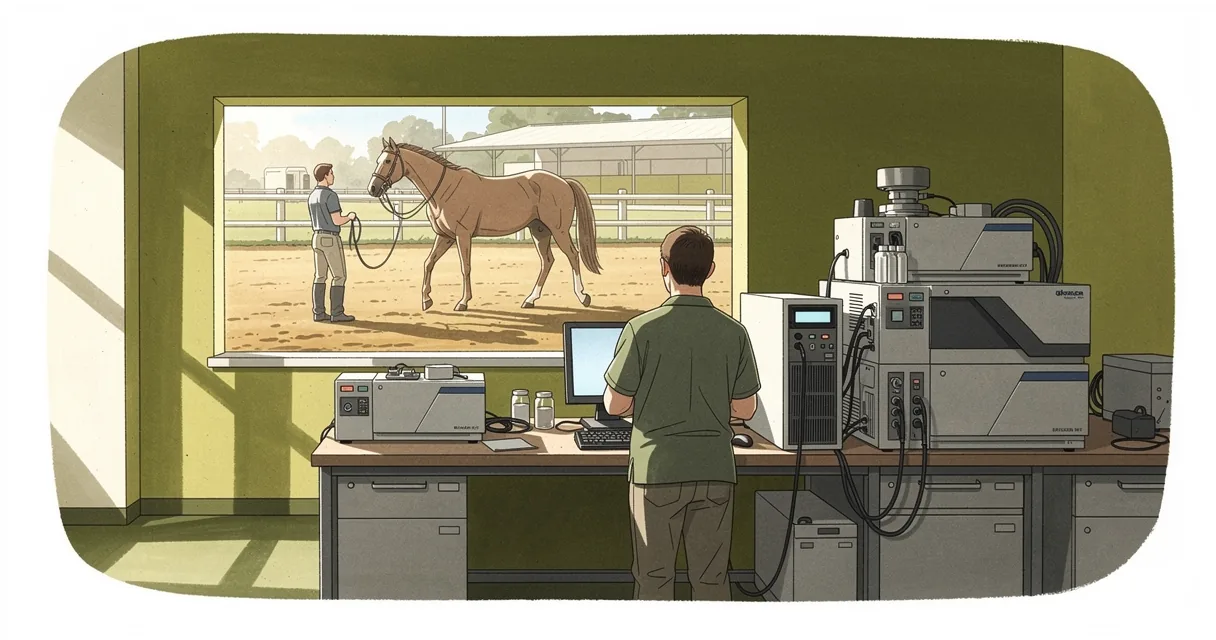
A chemical fingerprint from the horse-testing lab
The work that pins down TB-500 itself is surprisingly practical. In 2012, Esposito and colleagues synthesized and characterized the fragment for doping-control reference. That same year, Ho and colleagues detected TB-500 and its breakdown products in horse urine and plasma. The question was whether an instrument could identify the substance after administration, rather than whether an injury healed.
Those papers give the name a chemical fingerprint: Ac-LKKTETQ, the synthetic, acetylated fragment corresponding to residues 17–23 of thymosin beta-4. They do not give it a human treatment result. I trust that fingerprint more readily than the healing reputation; it answers a question the experiments actually asked.
The later analysis of misbranded and adulterated peptide preparations adds another complication. A familiar name on a preparation does not settle its identity. Before an effect can be attributed to a molecule, there has to be some confidence about which molecule was present.
TB-500 peptide: the family resemblance is real
Thymosin beta-4 is a protein present in nearly all human cells. It helps manage actin, the material cells use for their internal framework and movement. Its repair literature ranges across wounds, blood vessels, hearts and other tissues. TB-500 copies a short part of that protein, including its actin-binding motif.
The resemblance explains the interest. It does not make the fragment interchangeable with the parent. Nearly all the human work discussed here used full-length thymosin beta-4, while controlled human evidence for the TB-500 fragment remains missing. The distinction sounds fussy until an eye-drop study becomes a claim about muscle recovery.
The parent-protein page puts the two molecules beside each other. The research cases follow the results that survive a closer look, including mice that grew more regenerating muscle fibers without getting stronger.
A medical reputation has to do more than sound plausible
The appeal of a repair molecule is obvious to me. What bothers me is the ease with which a laboratory change becomes a promised recovery. In the dystrophin-deficient mouse study, more regenerating fibers did not produce significant gains in strength or heart function, and fibrosis remained elevated. That is a result worth leaving in the foreground.
There are also reasons for caution beyond disappointing outcomes. Thymosin beta-4 has been implicated in tumor spread and new blood-vessel growth in tumor models; this raises a theoretical safety concern, without establishing that TB-500 causes cancer in people. Community accounts describe both hoped-for changes and unwanted symptoms. They are anecdotes, not clinical evidence.
TB-500 has no FDA approval for human use. The withdrawn compounding nomination still carries FDA safety concerns. The TB-500 legal status page separates that record from a prescribing decision and from the pharmacy's separate requirements. Study amounts appear on the dosage page as experimental details, with no human recommendation attached.