Two related molecules
Thymosin beta-4 and TB-500 are different subjects
The parent protein is interesting in its own right. It does not need the fragment to stand in for it, and the fragment cannot inherit every result.
The fragment has an address within the parent
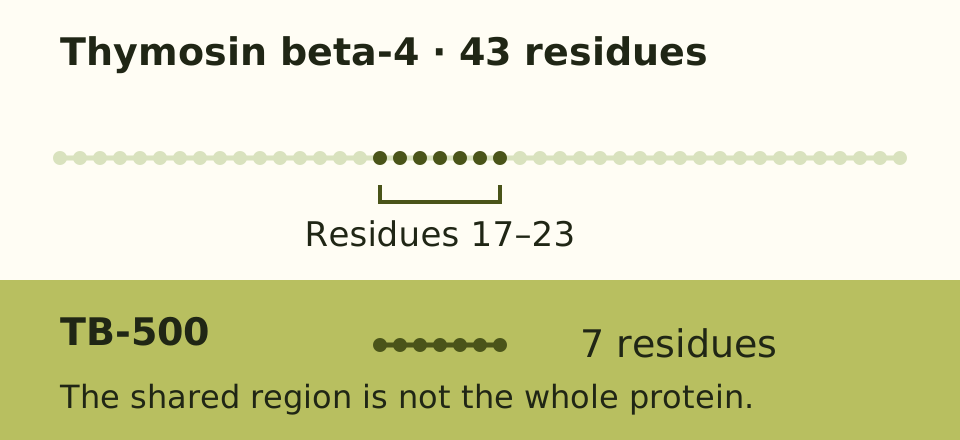
The synthesis paper identifies TB-500 as the acetylated fragment corresponding to residues 17–23 of thymosin beta-4. That makes TB-500 a 7-residue peptide; the full protein has 43 residues. A residue is simply an amino-acid unit within the chain.
The shared actin-binding region gives the molecules a real chemical connection. What I cannot accept is the next step: treating a shared region as proof of interchangeable effects. The thymosin beta-4 literature describes the whole protein's activities, including release by platelets and macrophages at injury sites. TB-500 is a synthetic construct distinct from the endogenous whole protein.
The full protein also yields Ac-SDKP, a separate cleavage product with anti-fibrotic and angiogenic activity. The TB-500 fragment cannot produce it. That alone makes a blanket transfer of the parent's mechanisms too simple.
One actin molecule, held out of a filament
In the structural study by Irobi and colleagues, thymosin beta-4 held globular actin in a 1:1 complex, capping both ends of the monomer so it could not polymerize into a filament. This helps explain how the protein manages a reserve of unassembled actin inside cells.
The study resolved a hybrid protein bound to actin, using gelsolin-domain-1 as part of that construct. I like the precision of this experiment: the structural question has a structural answer. Calling it proof that a TB-500 preparation repairs a human injury would discard what the investigators actually built and measured.
The eye work deserves its own place
The 2015 placebo-controlled dry-eye trial reported improvements in some signs and symptoms with thymosin beta-4 ophthalmic solution, although both primary endpoints were missed. Those missed endpoints prevent me from calling it a clean success.
The 0.1% RGN-259 corneal-healing study is part of the same topical thymosin beta-4 program, and the ARISE-3 registry entry records another dry-eye trial. These are studies of a local ophthalmic formulation. Their setting matters as much as the protein name.
An eye-drop result cannot establish an injectable fragment's effect on muscle. Nor does a tolerability result in healthy volunteers establish the fragment's long-term safety. Those substitutions are where the apparent human TB-500 record grows larger than the actual one.
A clinical record can have a blank ending
Ruff and colleagues studied intravenous full-length thymosin beta-4 in 40 healthy volunteers. That early safety and pharmacokinetic study leaves TB-500 injury treatment unproven.
The cardiac registrations tell a less tidy story. NCT01311518 was a heart-attack trial withdrawn before initiation, with enrollment 0. The later acute myocardial infarction trial completed, with no results posted in the research record used here. Acute myocardial infarction means a heart attack; the withdrawn registration was not a stroke trial.
That blank ending does not trouble me; pretending to know it would. A hoped-for result remains a hope, and full-length thymosin beta-4 remains the intervention in these records.