Amounts with an experimental address
TB-500 dosage: whose experiment supplied the number?
A number can be exact and still answer the wrong question. The subjects, molecule and route decide what these study amounts mean.
The rat result breaks the bigger-is-better story
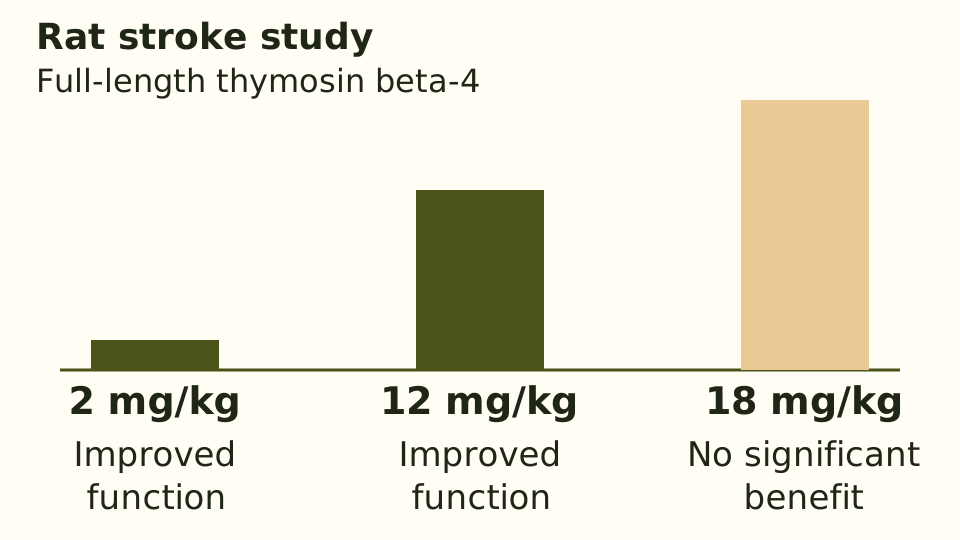
In Morris's stroke dose-response study, male Wistar rats received full-length thymosin beta-4 intraperitoneally, meaning into the abdominal cavity. The study tested 2, 12 and 18 mg/kg. Neurological function improved at 2 and 12 mg/kg, with significant differences from day 14 through day 56; 18 mg/kg produced no significant benefit. The modeled optimal dose was approximately 3.75 mg/kg.
The larger-amount argument strikes me as wishful when this animal experiment directly contradicts it. It does not identify a human TB-500 amount: these were rats after an experimentally induced stroke, and the intervention was the whole protein.
Community loading-and-maintenance plans have no published clinical validation for the fragment. The shape of this animal result supplies no rationale for turning one into a human schedule.
TB-500 half-life: the missing measurement is still missing
The human intravenous study gave full-length thymosin beta-4 to 40 healthy volunteers in four cohorts of 10, using 42, 140, 420 or 1260 mg. It reported infrequent mild or moderate adverse events, no dose-limiting toxicities or serious adverse events, and dose-proportional pharmacokinetics. The protein's half-life increased with dose.
A half-life measures the time taken for the amount in the body to fall by half. There is no validated human half-life for the TB-500 heptapeptide in this research record. The equine detection work identifies the fragment and its metabolites in horse samples; those findings concern equine detection.
A confident TB-500 half-life without a fragment-specific human experiment tests my patience. The nearest measured human experiment still concerns a different molecule.
TB-500 oral claims have no human result to point to
The human work here used intravenous full-length thymosin beta-4 or topical ophthalmic solution. Much of the animal repair work used intraperitoneal administration or topical application. Those routes are specific experimental details; each requires its own evidence for the result.
No controlled human evidence here establishes useful oral delivery of TB-500. Peptides are susceptible to breakdown, and an oral preparation needs its own absorption and clinical evidence. Moving a number from a vein study onto an oral claim does not supply either.
The legal record explains why a prescribing decision and permission to compound are separate questions.
A label can't prove the contents. A prescription adds medical review
Research-grade TB-500 is supplied as a lyophilized (freeze-dried) powder, typically reconstituted in bacteriostatic or sterile water and kept refrigerated [6]. As a short acetylated peptide it is more chemically robust than the full-length protein, but it is still subject to proteolysis and freeze-thaw degradation [6]. Identity and purity of unregulated material is a recurring concern — correct sequence (full-length versus fragment) is not guaranteed — which complicates interpreting any anecdotal result [6]. Community "loading then maintenance" protocols are not derived from controlled human trials and have no published clinical validation; the non-monotonic stroke dose-response (no benefit at the highest 18 mg/kg dose) directly argues against "more is better" loading logic [4].
Identity and purity are also the one variable a reader cannot verify from a product page, and it is where the two access routes diverge most sharply. Material bought as a research chemical arrives with whatever the seller asserts about it. A compounded preparation arrives against a patient-specific prescription, from a licensed pharmacy, with a prescriber's evaluation behind it. At Promise Peptides (mypromise.com), TB-500 prescribing now starts with a licensed U.S. clinician assessing the case and deciding whether to write a prescription. A request can be refused. Patients must be in the United States; choices depend on both the state and the treatment. The compounded medicine does not have FDA approval. Naming the distinction is not a quality claim about any particular vial; it is the difference between a purchase and a prescription, which is the part the stability data above cannot speak to.